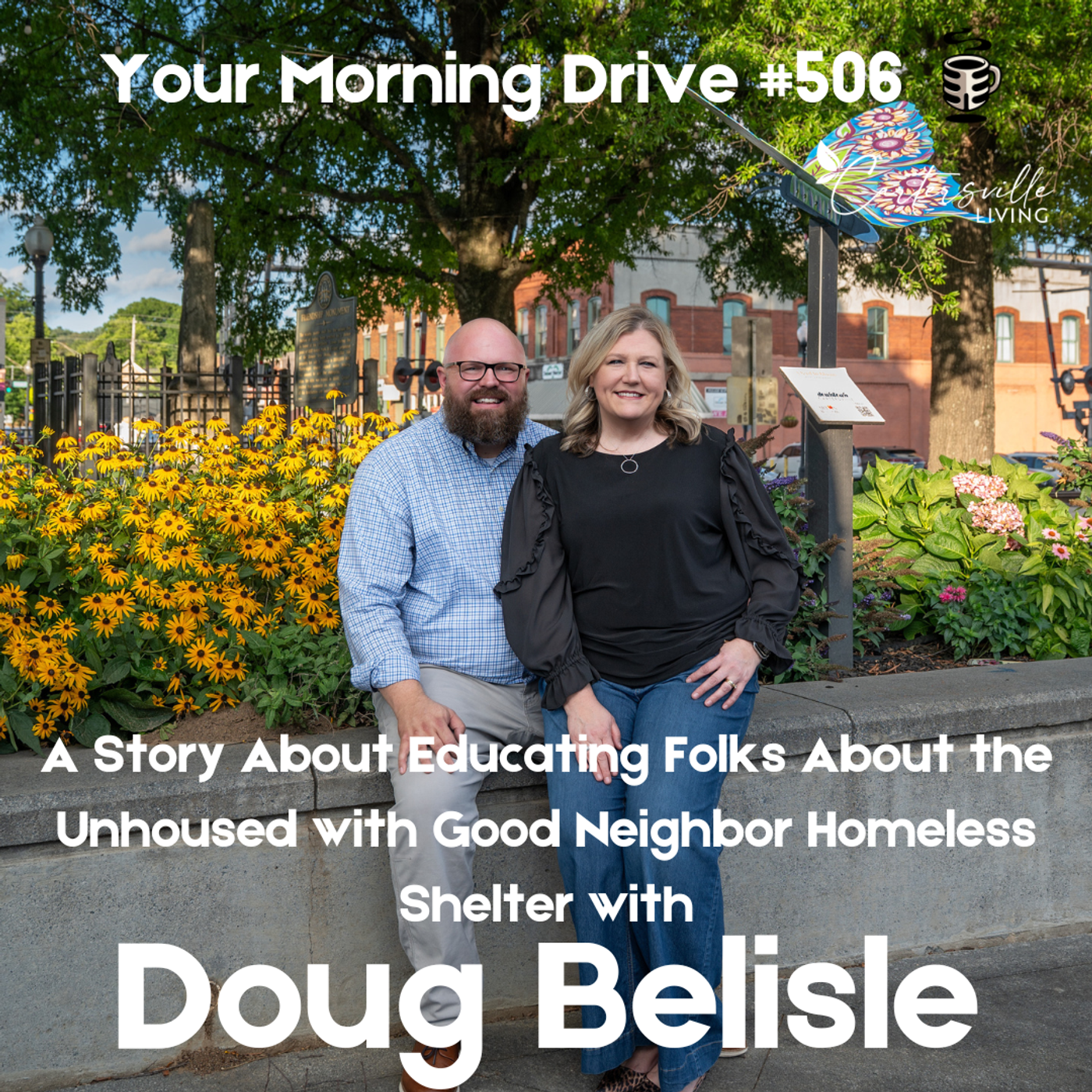
Doug Belisle sat down across from host Logan Lewis at 216 Coworking looking every bit the seminary-trained pastor turned nonprofit leader he is, and by the end of the conversation, Logan had gotten a lot more than a rundown of program names and donation links. Belisle is the Executive Director of Good Neighbor Homeless Shelter in Cartersville, Georgia, a certified TBRI practitioner who has spent nearly two decades learning, often the hard way, what actually separates a person from a roof over their head. What started as small talk about a magazine cover shoot turned into one of the show's more eye-opening episodes, built around the specific, maddening logistics of trying to get help with nothing.
From the Colorado Plains to a Calling He Couldn't Outrun
Belisle grew up on Colorado's eastern plains before his family settled in a Denver suburb, the son of a car salesman and a homemaker. Private Christian school pointed him toward faith early, but full-time ministry was never the plan. "I wanted to join the Air Force and be a fighter pilot," he told Logan, laughing about the moment at a Bible camp when he felt a clear call toward ministry and tried to negotiate his way out of it. He held out until senior year of high school before surrendering, which sent him to Oklahoma Baptist University and then Southwestern Seminary in Fort Worth, Texas, where he studied theology, met his wife, and eventually landed on staff at Cartersville First Baptist Church in 2007 — the job that first brought the Belisles to Bartow County.
A Family Built Through Adoption
One of the episode's most personal turns came when Logan, navigating his own family's difficult road toward having kids, asked Doug point blank about adopting his youngest son, who is Black and was adopted domestically, right there in Cartersville. Belisle didn't dodge it, candid about the fear that came with the eighteen months of prayer and research he and his wife spent deciding. What he didn't expect was how much parenting a child whose story diverged from his other two kids would reshape his career: realizing his usual instincts didn't fit reframed how he thought about trauma altogether, and that personal education became the seed of the trauma-informed training — TBRI, Trauma 101, Poverty 101 — now underpinning everything Good Neighbor does.
A Nearly Half-Million-Dollar Night
Good Neighbor's signature fundraiser, its annual Dancing with the Stars event, pulled in close to half a million dollars this year, a number that stunned even Belisle. "No one was expecting that kind of success," he said, noting the team plans nine months a year to pull it off. What makes it more remarkable, he argued, is the math: Bartow County has roughly 120,000 residents, nowhere near the donor base of a county like Cobb, yet supports a staggering number of nonprofits. "There's like 750 registered nonprofits in our county," he said, crediting Cartersville's culture of collaboration, not competition, for letting Good Neighbor, All In or All Out, and the Compassion Center all thrive at once.
Night in a Box: How One Borrowed Idea Became a Movement
Belisle also told the origin story behind Tim Abbott's now-famous Night in a Box event, witnessed firsthand while he was still at Bartow Collaborative. Abbott, prepping for his own turn on Dancing with the Stars, wanted an idea that would raise both money and awareness. Belisle remembered a high school football teammate in Denver who ran something similar for his own homelessness nonprofit and simply asked if they could borrow it. "He goes, 'Yeah, take it, man,'" Belisle recalled. Abbott turned it into his signature move, always picking the most brutal weather he can find to sleep outside in a cardboard box, and the shelter now runs a business-and-family version every November ahead of Hunger and Homeless Awareness Week.
The 13-Hour Walk to Rome
The conversation's sharpest moment came when Belisle walked Logan through exactly what it takes for someone sleeping in the woods to get a job. It starts with identification most people never think twice about: a birth certificate, then a state ID, then a Social Security card, often lost in a storage unit no one could afford anymore. Replacing a birth certificate means proving who you are with no ID to prove it. Reaching the nearest Social Security office, in Rome, means walking roughly thirteen hours each way for someone without a car — only to be turned away at the door by a guard asking, "Do you have an appointment?" "I don't have a phone," Belisle said. "Online is that might as well be like asking me to turn a backflip." A cardboard sign on a highway exit, he argued, can feel more realistic than navigating a system built for people who already have an address.
Believing for Them Until They Believe for Themselves
Logan pushed Belisle on something that had genuinely rattled him: why some unhoused people decline help even when it's offered, a moment he experienced firsthand handing out shoes at a homeless camp with fellow nonprofit leader Kevin Harris. Belisle answered with an old research story about mice in an electrified maze, shocked randomly and unpredictably until they simply stopped trying and lay down. "Everything that they tried resulted in some sort of negative consequence," he said, explaining that people who've failed to escape homelessness repeatedly often internalize it as identity: "They take on the identity, I'm homeless... I'm the problem." The staff's job, he said, is to "believe for them until they can believe for themselves" — and he's watched people transform in as little as three weeks once someone starts holding their hand through the process.
Listen to the Full Conversation
Doug Belisle's episode is one of the most quietly powerful conversations Your Morning Drive has put out this year, covering everything from a horror-movie obsession to the real steps between a park bench and a paycheck. Catch the full episode on Apple Podcasts, Spotify, or YouTube, and learn more about supporting Good Neighbor Homeless Shelter in Cartersville, Georgia.
Listen to Episode #506
Catch the full conversation with Doug Belisle on Your Morning Drive, wherever you listen.