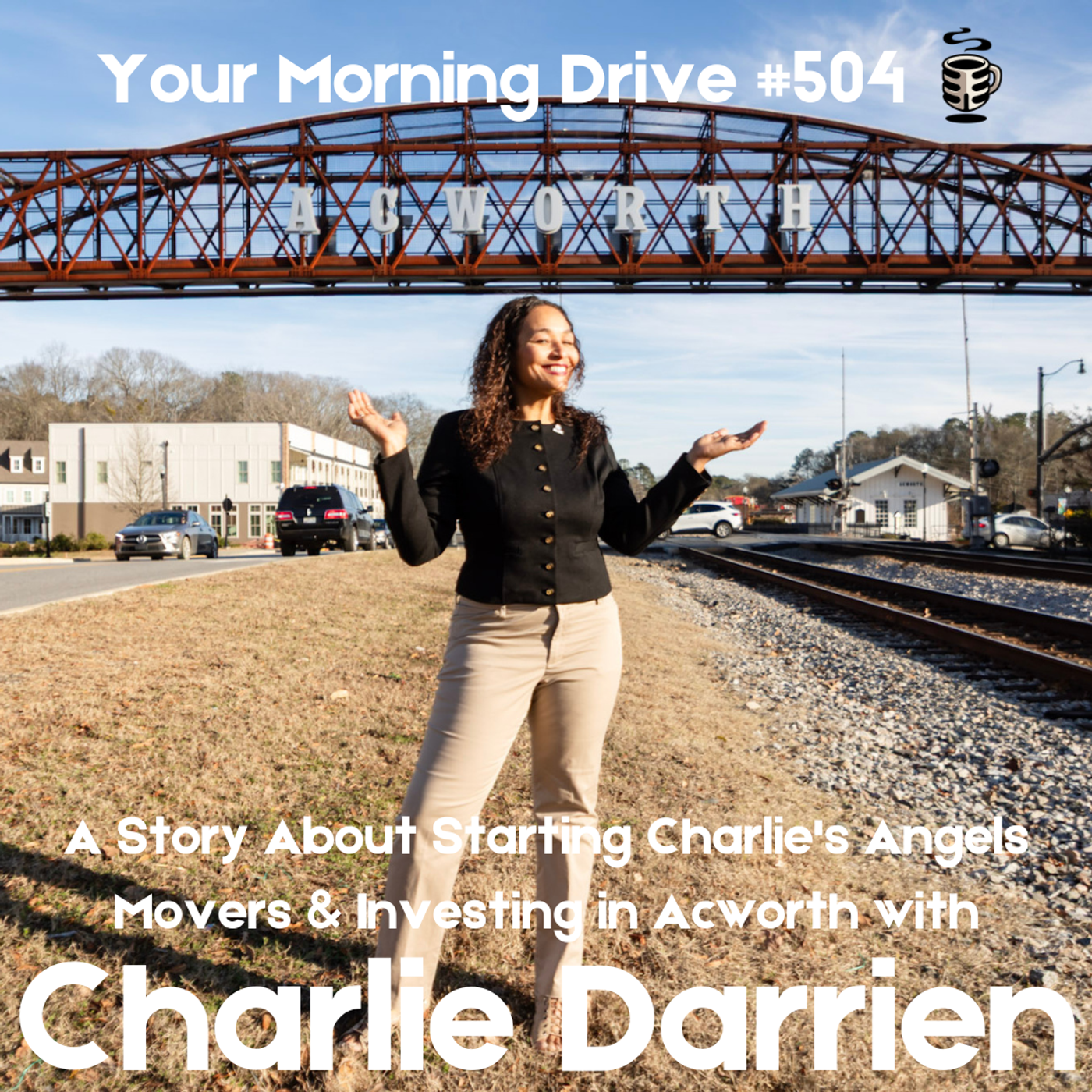
Charlie Darrien walked into 216 Coworking the way she walks into most rooms — quietly, warmly, and completely unbothered by her own resume — and by the end of the conversation, host Logan Lewis had unpacked a lot more than moving-company small talk. Charlie is the founder of Charlie's Angels Movers, grown from a $1,500 box truck into a name on billboards across metro Atlanta. But the moving company is just one basket in a very full pair of hands: a charity built from donated furniture, an event venue carved out of raw dirt, a music studio raising up Acworth's next generation of artists, and a board seat bringing live theater back to downtown Acworth. On episode 504 of Your Morning Drive, recorded from 216 Coworking in Cartersville, Logan and Charlie talked through how a broken industry and a lot of showing up turned into thirteen years of building — and why she isn't close to done.
"Give Me an Idea, God": How Charlie's Angels Movers Started
Charlie's path started with an army medic father and a childhood bouncing between Tacoma, Oklahoma, and Kentucky — an upbringing that, as she put it, conditioned her family to treat each other as "everything." Her first real sales education came at Radio Shack, where she started at nineteen and learned that being nice to people paid literal commission checks. Years later, stuck in corporate retail management after getting passed over for a promotion, she said a prayer that became the origin story of the business: "God, give me anything. Just give me an idea. Just put it in my head and I'll take it from there." Two months later, she resigned. Charlie's Angels Movers launched six months before she finished college — a play on her own name and the movie, leaned into so hard that Sony Productions called: "You're not going to own legally any rights to anything, but if you want any legal rights or want to trademark anything, there's going to be big problems." She kept the name and the lawyers left her alone.
Building a Business By Showing Up — Even When They Threw the Cards Away
Charlie courted real estate agents with cookies and business cards, fully aware most cards went straight into the trash. She kept coming back anyway. "I was consistent," she said. "Nobody wanted to refer movers over to anybody because the industry is a nightmare." Once a few agents used her for their own moves, the referrals opened up for real. She also caught a lucky break in timing — launching July 13th, dead in the middle of moving season, which she compared to "opening a boutique in December before Christmas." Thirteen years later, she no longer touches day-to-day operations. "I have a brilliant COO," she said. "First year ever that I haven't touched operations, so that feels really good."
"Is There a Man I Can Talk To?"
Long before movers, Charlie was the only woman on the sales floor at Radio Shack, and customers let her know it. "Is there a man I could talk to?" was a regular request. Her move was to fetch her coworker Brian and start dusting a shelf while she waited — because nine times out of ten, Brian turned right back around and asked her the answer. "There's nothing about a capacitor, a diode, hooking up your home theater system, wiring, that I couldn't tell you and explain better than everybody in there," she said. That dynamic followed her into moving, a business she admits almost no woman would think to start. Her billboard campaigns leaned into the confusion on purpose — "are they all women that's moving?" became free marketing. On site, she spent her whole first year as one of the movers on every crew, both because clients expected a man and because you can't lead a crew you've never worked alongside.
The Charity Truck, Heaven on Earth, and a Studio Called H2
The charity truck wasn't a business plan — it grew out of that same first $1,500 box truck, which Charlie also used to feed people under bridges and haul a barber around for free haircuts. When a stranger offered to write her a $15,000 check for work she was already doing, she realized she needed to formalize it. Now the charity runs on donated furniture from her moving clients, resold cheap, with all proceeds going back into Acworth. Heaven on Earth Event Venues followed a similarly organic path — she bought a property that was, in her words, "just dirt" with "a literal toilet in the driveway," and as she worked it herself, neighbors started pulling into her driveway to ask what she was building. It's now a sought-after photography and event venue. Meanwhile, H2 Studios grew out of a home studio built for her son Dane, a singer she's cultivated since age eight and now manages alongside a second artist she says looks and sounds so much like the rapper Future that she did a double take the first time she met him.
Investing in Acworth's Arts Scene
The investing thread in Charlie's story isn't stocks or real estate flips — it's Acworth itself. As chair of Acworth Cultural Arts, she's helped bring a working theater to the city and is filling its calendar with comedy and performances so residents don't have to drive into Atlanta and pay big-city parking and dinner prices for a night out. "You could spend the evening or the whole afternoon in Acworth," she said, pointing to the newly opened Tap House as proof the town's momentum is real. Looking ahead, Acworth Cultural Arts is planning a music series for next year. It's the same instinct that built everything else in her world: fill a need before anyone asks. As she quoted her mentor Zig Ziglar, "If you help enough other people get what they want, by default, you always get what you want."
Listen to the Full Conversation
This episode is full of stories that didn't make this recap — including Charlie's read on burnout, her love of calisthenics and bird watching, and a music festival lineup that somehow lands on Outkast, Garth Brooks, and her own son. Hear the entire conversation with Charlie Darrien on episode 504 of Your Morning Drive, available now on Apple Podcasts, Spotify, and YouTube.
Listen to Episode #504
Catch the full conversation with Charlie Darrien on Your Morning Drive, wherever you listen.