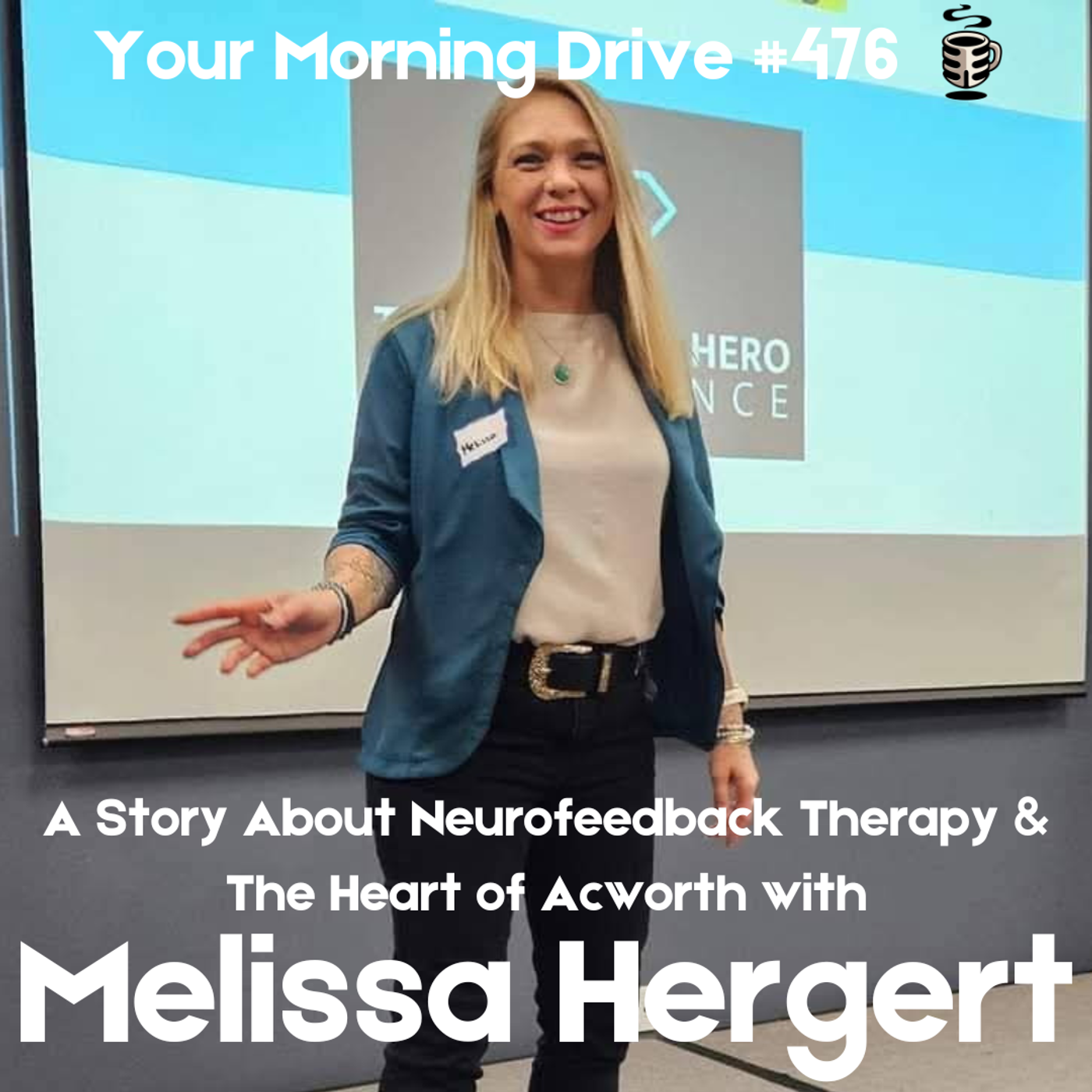
Melissa Hergert sat down at Gather Studios in downtown Acworth and gave host Logan Lewis two full hours of material, though you'd never know it from how naturally the conversation moved. Hergert is the founder of Brain Train Centers, a neurofeedback therapy practice she has grown from a single $4,000 student-loan check into a licensing network stretching into Texas, Hawaii, Oklahoma, Florida and beyond. But long before she was mapping brainwaves for a living, she was the only white girl in a rough San Diego neighborhood, raised on welfare by a mother who once fled to a homeless shelter with nothing but a friend and a plan. On episode 476, Hergert traced the line from that childhood through an abusive relationship in Las Vegas, a one-way plane ticket back to Georgia, and years of grinding it out, all the way to the business she runs today and the nonprofit makerspace she and her boyfriend are building inside a dead biker's old auto shop on Acworth's Main Street.
A Childhood Built on Grit, Church and Hard Lessons
Hergert was born in San Diego after her mother, raised in a wealthy Buckhead family, was cut off for having a mixed-race child in 1974 and eventually took off for California with her best friend, no money and no plan, landing first in a homeless shelter. Hergert grew up in a neighborhood with gang members on both sides of the street and stabbings and shootings that felt normal to her. 'Even though I was a little white girl, everyone watched out for me,' she said. 'I was protected.' Her stepdad, a Vietnam veteran and electrical engineer who worked on some of the earliest Qualcomm cell phones, was also a severe alcoholic who Hergert remembers hiding household chemicals from before school. He died when she was 15. His paycheck, and later a scholarship after the school board saw how involved she was leading chapel and organizing mission trips to Mexico, got her through a small private Lutheran high school despite her family's poverty.
A One-Way Ticket Out of Vegas
After high school, Hergert enrolled at San Diego State but never finished, working three jobs just to keep her own studio apartment near the beach. A trip to Las Vegas for a hair show led to a relationship with a timeshare salesman that turned physically and mentally abusive. 'It got really bad,' she said. 'I could have been dead.' A friend bought her a one-way plane ticket to Georgia, and Hergert arrived with nothing but a suitcase and her dog, Shady. She restarted her life from scratch, enrolled in chiropractic school at Life University, and met the man who would become her husband and the father of her two daughters in a physics class. She left chiropractic school a year and a half in, once the coursework required actually touching patients. 'It's okay to quit,' she told Logan. 'If you're not passionate about it, find something you enjoy.'
Building Brain Train Centers on a $4,000 Loan Check
Hergert's path into neurofeedback was an accident. Working the front desk for a chiropractor in Norcross, she asked what was happening in the room with 'all the brain stuff,' talked her way into becoming a technician, and doubled the practice's business through her own marketing efforts. At 30, with a three-year-old daughter and a husband who was a pro rugby player only paid when on tour, she struck out on her own with no savings and bad credit. Her solution: re-enroll at Life University purely to collect a $4,000 student loan disbursement, funding the first two months of what was then called Brain Core, one rented room in a Marietta chiropractor's office. The practice, rebranded Brain Train Centers around COVID, once grew to 22 locations across states including Texas, Hawaii, Oklahoma and San Diego through a Chick-fil-A-inspired licensing model rather than a franchise. She's now in talks with an NFL team psychologist about opening a location tied to a ketamine clinic near Sandy Springs.
What Actually Happens in a Neurofeedback Session
Asked to break it down 'like I'm five,' Hergert explained that clients wear a sensor-lined cap during a QEEG, or quantitative electroencephalogram, mapping which areas of the brain fire too fast or too slow. Contrary to popular belief, ADHD brains typically run too slow, not too fast, which is why stimulant medications work by speeding activity up. From there, neurofeedback therapy uses operant conditioning, the same principle behind potty-training a toddler, delivering real-time audio and visual rewards when a client's brainwaves shift into the correct pattern. 'It's teaching your brainwaves how to change and process in a new way,' she said. Lasting change, she noted, typically requires 30 to 40 sessions over three to six months, since the goal isn't masking symptoms but retraining the brain itself.
Honoring Motorcycle Mike and Building the Heart of Acworth
Hergert also hosts her own Facebook livestream, Heart of Acworth, and runs the 5,000-plus member Acworth Connects group, both born from a desire to actually know her neighbors after a failed first venture, the Museum of Lamps and Plants, closed two days after opening when the rented building's roof started leaking. That heartbreak led her and her boyfriend to a bigger project: buying the long-abandoned Cycle Auto Shop on Main Street from the daughters of its late owner, known locally as Motorcycle Mike, after Hergert offered to clean out the property for free. While clearing the office, she found his old pocket calendar, empty except for three dates: his daughters' birthdays and his wife's. 'This man was human,' she said. 'He had love.' The building is becoming D&B Makerspace, doing business as Gather Studios, a nonprofit offering 3D printing, sewing, content creation space and small-motor customization, with a wooden replica of Mike's original shop sign hanging under the awning as tribute.
Listen to the Full Conversation
From a homeless shelter in San Diego to a licensing network of neurofeedback clinics and a nonprofit makerspace honoring a local legend, Melissa Hergert's story is proof of what she calls just doing whatever it takes. Hear the full conversation, including her take on self-talk, phone habits and brain health, on Apple Podcasts, Spotify or YouTube.
Listen to Episode #476
Catch the full conversation with Melissa Hergert on Your Morning Drive, wherever you listen.